 | Chapter 50 - The -KA- Tenses |
|---|
The tense marker -KA- indicates the consecutivity of an action in relation to another.
| We distinguish 3 uses of the infix marker -KA- : | 1. The PAST NARRATIVE
2. The CONSECUTIVE SUBJUNCTIVE 3. The TELEGRAPHIC STYLE |
1. THE PAST NARRATIVE :
The Past Narrative exists only in the affirmative.
The infix -KA- is placed between the afirmative subject prefix and the verb radical. This tense accomodates object infixes, but cannot be used in relative constructions.
A) PAST NARRATIVE - AFFIRMATIVE FORM :
MODEL : KUFANYA = to make, to do
| NI-KA-FANYA | -> nikafanya | and I made |
| U-KA-FANYA | -> ukafanya | and you made |
| A-KA-FANYA | -> akafanya | and he / she made |
| TU-KA-FANYA | -> tukafanya | and we made |
| M-KA-FANYA | -> mkafanya | and you made |
| WA-KA-FANYA | -> wakafanya | and they made |
NOTE : Monosyllabic verbs drop their infinitive prefix KU- :
MODEL : KWENDA = to go
| NI-KA-ENDA | -> nikaenda | and I went |
| U-KA-ENDA | -> ukaenda | and you went |
| A-KA-ENDA | -> akaenda | and he / she went |
| TU-KA-ENDA | -> tukaenda | and we went |
| M-KA-ENDA | -> mkaenda | and you went |
| WA-KA-ENDA | -> wakaenda | and they went |
B) USE OF THE PAST NARRATIVE :
The Past Narrative (the -KA- tense) is used for narration, but it is often preceded in speech by a first verb in the Simple Past, be it affirmative or negative :
| EXAMPLE : | Nilikwenda kijijini, nikamwona rafiki yangu, nikamwomba aje nami mjini, akakubali. I went to the village, I saw my friend, I asked him to come with me to town, and he accepted. |
This example shows that the word NA (= and) is never expressed : this concept is already contained within the tense marker -KA.
To express negation, we use the Subjunctive negative instead. (See : Chapter 33 - The Subjunctive.)
| EXAMPLE : | Nilikwenda markiti, nikatafuta tungule (nyanya), nisipate. I went to the market, I looked for tomatoes and I didn't find any. |
OTHER EXAMPLES :
Nilikwenda Zanzibar jana nikarudi leo.
I went to Zanzibar yesterday and I came back today.Alifika Mombasa, akajaribu kupata chumba hotelini, asipate.
He arrived in Mombasa, he tried to find a hotel room, and didn't get any.Nilimwona mlimaji shambani, nikamwuliza : "Je, umepata mavuno mazuri ?" akasema : "Bwana, sikupata kitu".
I saw a farmer on his plantation, I asked him : "Tell me, Have you got good harvests ?" and he answered : "No, I haven't got anything at all".Mzungu alifika Moshi, akaona mlima mkubwa sana, akamwuliza mwenyeji : "Je, mlima gani ule ?" mwenyeji akamjibu : "Huu ndio mlima wa kilimanjaro".
The white man arrived in Moshi, he saw a very high mountain, then he asked a villager : "What's this mountain ?" the villager answered him : "This is indeed Mount Kilimanjaro".
2. THE CONSECUTIVE SUBJUNCTIVE :
A) CONSECUTIVE SUBJUNCTIVE - AFFIRMATIVE FORM :
The tense marker -KA- is inserted in the verbal construction of the subjunctive affirmative.
MODEL (Verbs of Bantu origin) : KULETA = to bring
| NI-KA-LETE | -> nikalete | and that I bring |
| U-KA-LETE | -> ukalete | and that you bring |
| A-KA-LETE | -> akalete | and that he / she brings |
| TU-KA-LETE | -> tukalete | and that we bring |
| M-KA-LETE | -> mkalete | and that you bring |
| WA-KA-LETE | -> wakalete | and that they bring |
Verbs of Arabic origin keep their final vowel -E, -I, or -U :
| NI-KA-JARIBU | -> nikajaribu | and that I try |
| U-KA-JITAHIDI | -> ukajitahidi | and that you make an effort |
| A-KA-SAMEHE | -> akasamehe | and that he / she forgive |
Monosyllabic verbs drop their infinitive prefix KU- :
| NI-KA-JE | -> nikaje | and that I come |
| U-KA-LE | -> ukale | and that you eat |
| A-KA-ENDE | -> akaende | and that he / she goes |
| NOTE : | By its very nature the consecutive subjunctive can only be used with classes 1 / 2 (M-/WA- gender) subject prefixes. |
B) USE OF THE CONSECUTIVE SUBJUNCTIVE :
This tense is used in conjunction with the verb KWENDA :
Twende tukale ! or : Tukale ! Let's go and eat ! Aende akamwite ! or : Akamwite ! Let him / her go and call him / her !
The tense marker -KA- can also be used in the imperative of the second person singular. In that case it corresponds to a "sharp" order :
Kalete ! Will you bring ! Kamwambie ! Will you tell him / her ! Kajitahidi ! Will you make an effort !
Nenda can also be used in front of the imperative in -KA- :
Nenda kalete ! Will you go and bring !
EXAMPLES :
Twende tukailete mizigo yetu hapa. Let us bring our luggage here. Nenda kamwambie alete chai. Will you tell him to bring tea. Ukanunue sigara dukani. Will you buy cigarettes at the shop. Bwana yupo ? - Yupo. - Kamwite basi ! Is the boss here ? - He is here. - Call him then !
3. THE TELEGRAPHIC STYLE :
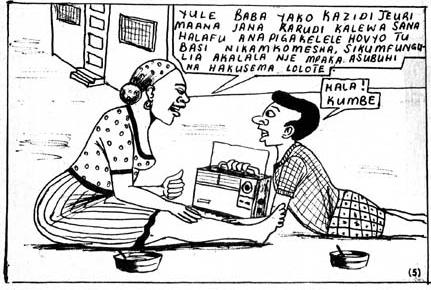
The -KA- tense is probably the only tense (apart from the imperative) that can be used used without a subject prefix, provided that the noun subject has been mentioned once in the sentence. This process is commonly used to make newspaper headlines in the daily press, but not exclusively, as will be seen in a cartoon extracted from Philip Ndunguru's comic book, Mzee Meko.
EXAMPLES :
| WAZIRI KAFA DEATH OF MINISTER |
| NDEGE KAANGUKA BAHARINI PLANE FALLS INTO SEA |
| MWIZI KAKAMATWA ROBBER CAUGHT |
MZEE MEKO, by Philip Neli Ndunguru :
|
Yule baba yako kazidi jeuri maana jana karudi kalewa sana halafu anapiga kelele hovyo tu. Basi nikamkomesha, sikumfungulia akalala nje mpaka asubuhi na hakusema lolote.
Your father has twisted the knife in the wound, for yesterday he came back home completely drunk, then he did a lot of noise, so I refused to open him and he slept outside until morning and he didn't say anything.
VOCABULARY
| Ada | expenses | Amani | peace |
| Adhabu | a punishment | Arusi | a marriage |
| Afya | health | Elimu | teaching, education |
| Aibu | shame | Fitina | an argument |
| Ajabu | a wonder | Fulani | someone |
| Akina | relations | Hadithi | a story |
EXERCISES
EXERCISE 1 : Translate into Swahili :
- Will you call the teacher !
- Let's eat now !
- Let them fetch the pupils !
- Will you clean my car !
- Would you go and read these books at the library.
- Will you go and buy me a bottle of Coke in the shop.
- Let us rest !
- Let's drink coffee now !
- If you don't know, go and ask !
- He went to fish, he fell into the river, and couldn't get out.
- They went hunting, killed an animal and ate it.
- We didn't go outside, we stayed at home and watched television.
EXERCISE 2 : Translate into English:
- Nenda katazame !
- Ukanilete maji, tafadhali !
- Wakaende kutuletea kuni nyingi
- Akanunua gari jipya, akalileta nyumbani, akalionyesha kwa kila mtu.
- Niliwapa watoto maembe yangu. Wakala.
- Bwana alipoingia, wale watu wakasimama wakamwamkia.
- Alipolikataa shauri letu tukanyamaza.
- Tembo walikuja usiku, wakauvunja ukuta wa shamba, wakaliharibu shamba lote.
- Mtoto yuko wapi ? - Yuko uani. - Kamwite basi !
- Usiongee na mtoto huyu, bali uende ukamwite mama yake.
- Tulikwenda Hoteli ya Kati, tukafaulu kupata chumba kimoja.
- Nenda kaone kama wazungu watakwenda Moshi kesho.
| Previous Chapter | Next Chapter | Table of Contents |
|---|